
How to Make a Website for Business in India (2026 Guide)
How to make a website for business in India: 8 steps, which platform to pick, pages you need, SEO basics, costs and common mistakes.
Table of contents
- What to prepare before you make a website for business
- Step 1: Decide what your website needs to do
- Step 2: Buy a domain in your own name
- Step 3: Choose how to build it
- Website builder
- WordPress
- Custom website
- Step 4: Plan the pages
- Step 5: Write content customers actually read
- Step 6: Make it easy to contact you
- Step 7: Set up basic SEO
- Step 8: Launch and connect your Google Business Profile
- Features that bring more enquiries
- How much does a business website cost?
- How long does it take?
- Do it yourself or hire a developer?
- Common mistakes to avoid
- An example: a coaching institute in West Delhi
- Frequently asked questions
- Can I make a business website for free?
- How many pages should a small business website have?
- Do I need a website if I have a Google Business Profile?
- Will my website show on Google immediately?
- What is the best way to make a website for business on a small budget?
- Can I update the website myself later?
- Get help making your business website
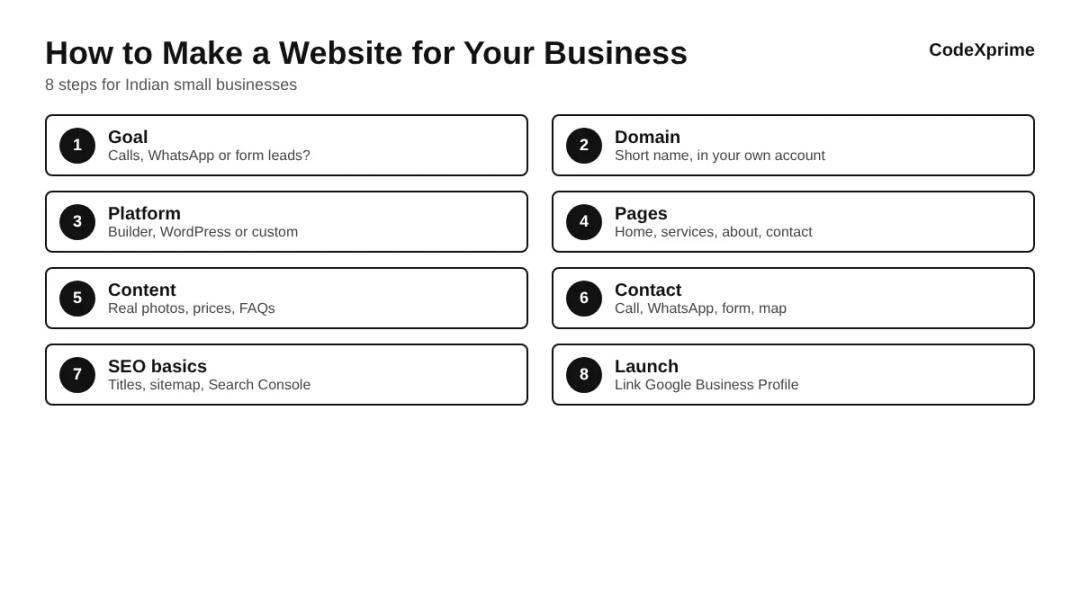
To make a website for business in India, decide what the website must do (usually bring calls or enquiries), buy a domain in your own name, choose how to build it (a website builder, WordPress or a custom site), create five to eight key pages, add real content and clear contact options, set up basic SEO, and link it to your Google Business Profile. A simple business website can go live in 5 to 20 days once your content is ready.
Most "how to make a website" guides come from website builder companies, so the answer is always "use our builder". This guide is written for Indian small business owners, such as clinics, coaching institutes, consultants, shops and service companies, by a team that builds business websites every week. It focuses on what actually brings enquiries, not just how to get a page online.
What to prepare before you make a website for business
Having these ready before you start saves days, whether you build it yourself or hire someone:
Your business name, logo and colours, if you have them
A list of services with a short description and, ideally, a starting price for each
The areas you serve, for example Dwarka, Janakpuri or all of Delhi
10 to 20 real photos of your work, team or premises
Phone number, WhatsApp number, email, address and working hours
Three or four websites you like, and what you like about them
Common questions customers ask you, with your answers
Step 1: Decide what your website needs to do
Before you think about colours or templates, answer one question: what should a visitor do after landing on your site? For most local businesses it is one of these:
Call you or send a WhatsApp message
Fill an enquiry or appointment form
Visit your shop, clinic or office
Pay a fee or book a slot online
Pick the main action and design every page around it. A coaching institute wants admission enquiries. A clinic wants appointments. A wholesaler wants quote requests. A website that tries to do everything usually does nothing well.
Step 2: Buy a domain in your own name
Your domain is your address online, like yourbusiness.in. Keep it short, easy to spell on a phone call, and close to your business name. A .in or .com works well for Indian customers. Most importantly, buy it with your own email and keep the login. Many owners later find their domain was registered by an old developer and can't be moved without a long chase.
Step 3: Choose how to build it
There are three common ways to make a business website. Each has a place.
Website builder
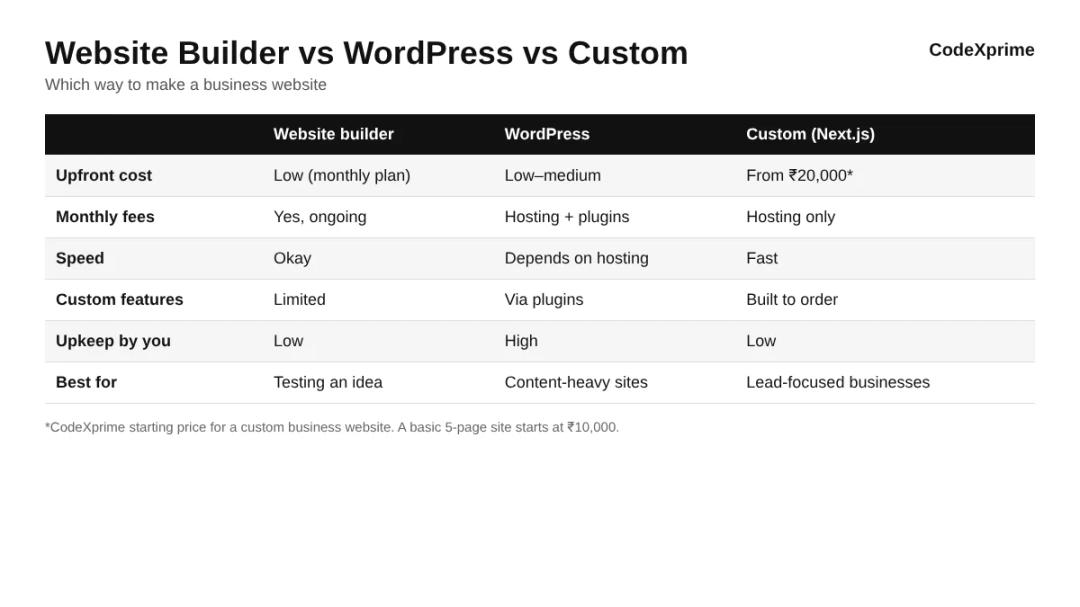
Tools like Wix, Squarespace or GoDaddy's builder let you drag and drop pages. They are quick and cheap to start, and fine for testing an idea. The trade-offs are monthly fees that never stop, limited control over speed and SEO, and a design that looks like many other sites.
WordPress
WordPress powers a large share of the web and is strong for blogs and content. You need hosting, a theme and usually several plugins. It gives you a lot of control, but it also needs regular updates, backups and security care. Heavy page-builder themes can make it slow on mobile.
Custom website
A custom website is built in code for your business, for example on Next.js. It costs more at the start but loads fast, has no plugin renewals and can include exactly the features you need, such as booking, fee payment or a price calculator. At CodeXprime, a basic 5-page website starts at ₹10,000 and a custom Next.js business website starts at ₹20,000. See custom website development for details.
Quick rule: testing an idea on a tiny budget, use a builder. Publishing lots of articles, WordPress can work. If the website is a main source of leads, a fast custom site usually pays back.
Step 4: Plan the pages
Most small business websites need between five and ten pages. Fewer, clear pages beat many thin ones.
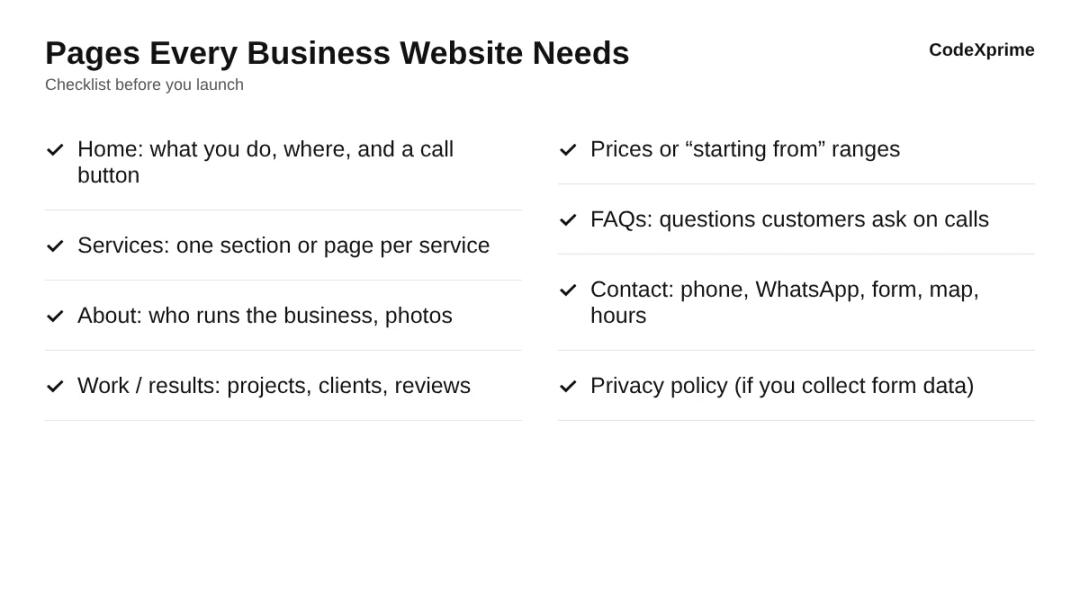
Home: say what you do and where, in one line, with a call or WhatsApp button visible without scrolling.
Services: one section or page per main service, so each can rank on Google for its own search.
About: who runs the business, how long you have been working, and real photos.
Work or results: projects, before-and-after photos, results or client names (with permission).
Prices: even a "starting from" range builds trust and filters out poor-fit enquiries.
FAQs: the questions customers ask you on the phone every week.
Contact: phone, WhatsApp, form, map, address and hours.
Step 5: Write content customers actually read
The text on your site matters more than the design. Write the way you would explain your service to a customer across the counter. Use short sentences, real numbers and plain words. Mention the areas you serve, such as "clinic in Dwarka" or "coaching in Uttam Nagar", because that is how people search.
Use your own photos wherever possible: your team, your premises, your work. Stock photos of smiling models make a site look like every other site and do not build trust. If you do not have good photos, a few hours with a local photographer is one of the best investments you can make.
Step 6: Make it easy to contact you
Every page should make the next step obvious:
A click-to-call button and a WhatsApp button that stay visible on mobile
A short enquiry form (name, phone, what they need) that sends straight to your email or WhatsApp
Your address with a Google Map, and your working hours
A quick reply. A great website is wasted if enquiries wait two days for a response
Step 7: Set up basic SEO
You do not need to be an SEO expert to get the basics right:
Give each page a clear title and meta description that includes your service and area
Use one main heading per page and short subheadings
Add alt text to images
Make sure the site loads fast on a phone using mobile data
Connect the site to Google Search Console and submit your sitemap
Add Google Analytics so you can see where visitors come from
Google's own SEO Starter Guide is a good free reference if you want to go deeper.
Step 8: Launch and connect your Google Business Profile
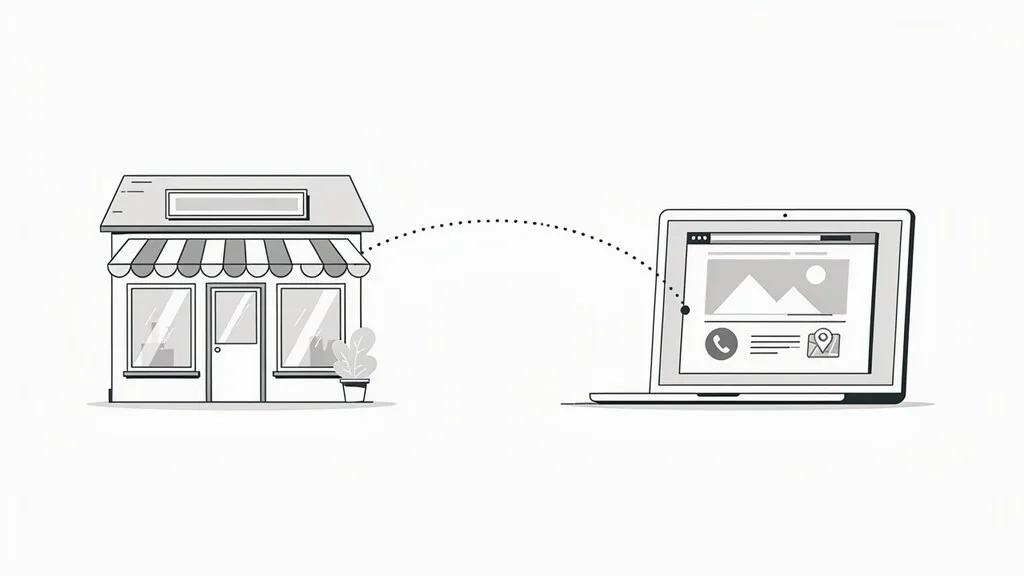
For local businesses, your Google Business Profile and your website work as a pair. People find your profile on Google Maps, then check your website before calling. Add your website link to the profile, and keep the business name, phone number, address and hours exactly the same on both. Post updates on the profile, add photos regularly, and ask happy customers for reviews.
Features that bring more enquiries
Once the basics are in place, a few extras make a clear difference for most local businesses:
Reviews on the site: show a few real Google reviews or client quotes near your contact buttons.
Online booking: clinics, salons and consultants get more bookings when customers can pick a slot themselves.
Price calculator or quote form: useful for services where price depends on size or quantity.
Blog or guides: short articles answering customer questions help you show up on Google for more searches.
Fast mobile pages: every extra second of loading time loses visitors, especially on mobile data.
Add these one at a time and watch which ones bring more calls. There is no need to launch with everything.
How much does a business website cost?
It depends on the number of pages, design and features. At CodeXprime, a basic 5-page business website starts at ₹10,000 and a custom Next.js website at ₹20,000. On top of that you pay for the domain and hosting each year. Our website development cost page has the full breakdown. If you plan to sell products online, read our guide on ecommerce website cost in India instead.
How long does it take?
Most business websites take 5 to 20 days once the content is ready. Bigger sites with booking systems, logins or many service pages can take 25 to 35 days. The most common delay is waiting for text and photos, so prepare these early.
Do it yourself or hire a developer?
You can make a simple website yourself on a builder if you have time, a small budget and only need a few pages. Hire a developer when the website is meant to bring regular enquiries, when you need speed and good SEO, or when you want features such as appointment booking or online payments. A good developer should also tell you when a simple builder is enough for you.
If you already have a website that is slow, outdated or not bringing enquiries, a website redesign may be better than starting from zero.
Common mistakes to avoid
Domain or hosting registered in someone else's name
No phone number or WhatsApp button visible on mobile
Copying text from other websites, which hurts trust and Google rankings
One long page with every service mixed together
Different phone numbers or addresses on the website and Google Business Profile
Launching and never updating prices, services or photos
An example: a coaching institute in West Delhi
A coaching institute wants more admission enquiries. A good website for them has a home page with courses and a WhatsApp button, one page per course with batch timings and fees, a results page with student achievements, an FAQ page, and a contact page with a map. The site is linked to their Google Business Profile, and each course page targets searches like "course name coaching in Uttam Nagar". This is the kind of setup we build for education businesses such as Shrestha Academy and Monark FX. If you are in Delhi, see our website development company in Delhi page.
Frequently asked questions
Can I make a business website for free?
Some builders offer free plans, but they usually show their branding and do not let you use your own domain. For a real business, plan for at least a domain and a paid plan or hosting.
How many pages should a small business website have?
Usually five to ten: home, services, about, work or results, prices, FAQs and contact. Add one page per main service if you want each service to rank on Google.
Do I need a website if I have a Google Business Profile?
Yes. The profile helps people find you on Maps; the website explains your services, builds trust and collects enquiries. Most customers check both before calling.
Will my website show on Google immediately?
No. New websites usually take a few days to be indexed and several weeks or months to rank for competitive searches. Submitting your sitemap in Search Console helps Google find it faster.
What is the best way to make a website for business on a small budget?
Start with five clear pages, real photos and strong contact buttons. Skip extras until enquiries start coming in. A basic professional site at CodeXprime starts at ₹10,000.
Can I update the website myself later?
You should be able to. Every CodeXprime website comes with an admin panel so you can change text, photos and prices without calling a developer.
Get help making your business website
CodeXprime builds business websites for Indian companies, designed around one goal: getting visitors to call, WhatsApp or fill your form. Message us on WhatsApp with what your business does, and we will suggest the right approach and price.
Written by Ritesh Kumar, founder and full-stack developer at CodeXprime. Ritesh has built websites and platforms for businesses across education, healthcare, fintech and e-commerce, including Shrestha Academy, Panacea Medcare and Monark FX.