
Ecommerce Website Cost in India (2026): Real Prices and Hidden Costs
Ecommerce website cost in India explained: Shopify stores from ₹15,000, custom stores from ₹25,000, running costs, 3 examples and red flags.

Table of contents
- Quick answer: ecommerce website cost in India (2026)
- What you are actually paying for
- Shopify, WooCommerce or custom: how the cost compares
- Shopify
- WooCommerce
- Custom store (Next.js)
- Running costs most quotes leave out
- Three examples with first-year cost
- 1. A home bakery or small food brand (20 products)
- 2. A clothing brand selling on Instagram (150 products with sizes)
- 3. A wholesaler in Delhi selling to shops (500+ products)
- Which features add to the cost
- Does the ecommerce website cost in India change by city?
- Questions to ask before you hire a developer
- How long does it take?
- How to keep your ecommerce website cost low (without cutting corners)
- Red flags in a cheap quote
- Own store vs selling only on marketplaces
- Is a custom store worth paying more for?
- Frequently asked questions
- What is the minimum cost of an ecommerce website in India?
- Is GST compulsory for selling online in India?
- Can I add products to the store myself?
- Do I own the website after it is built?
- How do I pay for the project?
- Get a quote for your store
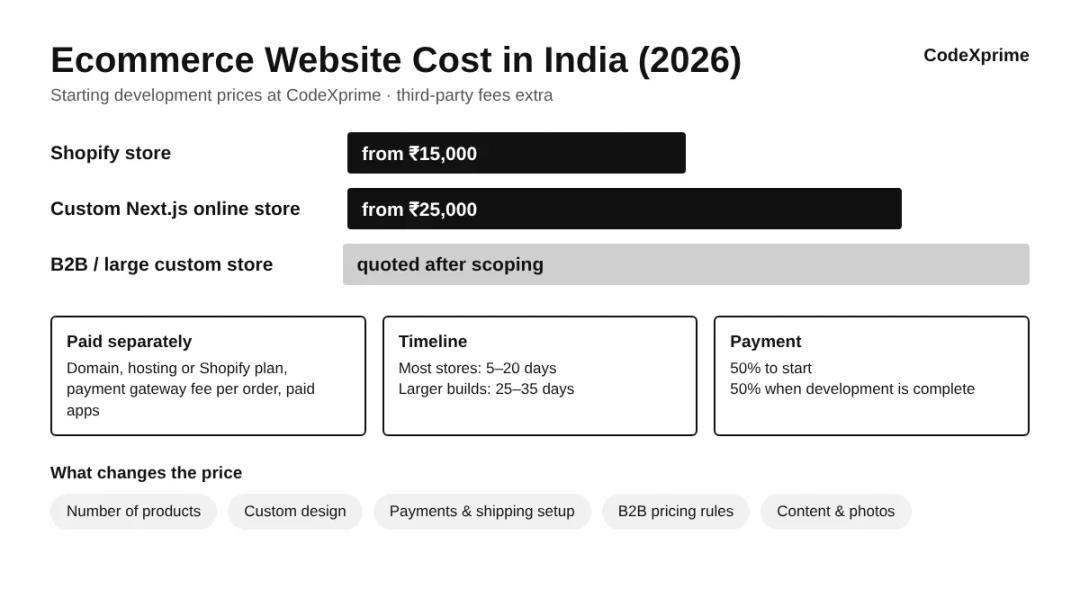
The ecommerce website cost in India is usually between ₹15,000 and ₹5,00,000 to build, and most small businesses can launch a good store for ₹15,000 to ₹50,000. At CodeXprime, a Shopify store starts at ₹15,000 and a custom Next.js online store starts at ₹25,000. On top of that you pay a few running costs every year: domain, hosting or a Shopify plan, and a small fee on every online payment.
That is the short answer. The longer answer depends on what you sell, how many products you have, and how much of the work you want done for you. This guide breaks the ecommerce website cost in India into parts, walks through three real-world examples, and lists the costs most quotes leave out.
Quick answer: ecommerce website cost in India (2026)
Type of store | Typical build cost | Best for |
|---|---|---|
DIY on a store builder | ₹0 build + monthly plan | Testing an idea with a few products |
Shopify store set up by a developer | From ₹15,000 (CodeXprime) | Small brands with up to a few hundred products |
WooCommerce store | Quoted per project | Businesses already on WordPress |
Custom Next.js store | From ₹25,000 (CodeXprime) | Brands that want speed, no platform fee and room to grow |
B2B, multi-vendor or ERP-linked store | Usually ₹1,00,000 and above | Wholesalers, marketplaces, large catalogues |
Prices from agencies vary a lot. Some large agencies start at ₹1 lakh or more even for simple stores, because they carry bigger teams and overheads. A freelancer may quote less, but you should check who will support the store after launch.
What you are actually paying for
When a developer quotes for an online store, the price covers a set of jobs. Knowing them helps you compare quotes properly.
Design: home page, category pages, product page, cart and checkout. A ready theme costs less; a design made for your brand costs more.
Product setup: adding products, variants such as size and colour, stock, and photos. Ten products take an hour. Five hundred products with variants can take days.
Payments: connecting a gateway like Razorpay for UPI, cards and netbanking, and setting cash on delivery rules.
Shipping: linking a service like Shiprocket so orders create courier pickups and tracking automatically.
Taxes and invoices: GST rates per product and invoices with your GSTIN.
Admin panel and training: a place to add products, see orders and download reports, plus a short call to show you how it works.
SEO basics: clean URLs, page titles, product schema and a sitemap so Google can find your products.
Testing: placing real orders end to end before launch.
If a quote looks very cheap, check which of these items are missing.
Shopify, WooCommerce or custom: how the cost compares
The platform you pick changes both the build cost and what you pay every month.
Shopify
Shopify is quick to launch and easy to manage. The trade-off is a monthly subscription, and paid apps for many extra features. For a small catalogue and a fast start, it is often the cheapest route in the first year. Read more on our Shopify development page.
WooCommerce
WooCommerce runs on WordPress. The software is free, but you pay for hosting, a theme and some plugins. It suits businesses that already have a WordPress site and want a blog and store together. Plugin renewals and updates are the costs people forget.
Custom store (Next.js)
A custom store is built in code for your business. It costs more to build than a basic Shopify setup, but there is no monthly platform fee and no limit on features. Pages load fast, which matters because most Indian shoppers buy on mobile data. This is what we build for most clients at CodeXprime (also see custom website development), for example the Genuine Nutrition supplement store, which runs on Next.js, Node.js and PostgreSQL with Razorpay and Shiprocket. See our ecommerce website development page for details.

Running costs most quotes leave out
The build is a one-time cost. These come every month or year, and they are paid to other companies, not to your developer:
Domain name: usually a few hundred to around fifteen hundred rupees a year, depending on the extension (.in, .com and so on).
Hosting or platform plan: a Shopify subscription (see Shopify India pricing), or hosting for WooCommerce and custom stores. Small custom stores can often run on low-cost cloud plans.
Payment gateway fee: a small percentage on every online payment. Check the current rates on your gateway's pricing page, for example Razorpay pricing, before you plan margins.
Shipping: courier charges per order, which you can pass on to buyers or include in prices.
Paid apps or plugins: reviews, wishlists, advanced filters and similar add-ons.
Maintenance: updates, backups and small changes after launch.
Ask your developer to list all of these in writing before you start. We do this in every CodeXprime quote, so the first-year cost is clear from day one.
Three examples with first-year cost
These are typical setups we see from small Indian businesses. Third-party costs depend on the plans you choose, so they are shown as items, not fixed numbers.
1. A home bakery or small food brand (20 products)
Needs: product pages, pincode-based delivery, UPI and COD, WhatsApp order alerts. A Shopify store fits well. Build cost at CodeXprime starts at ₹15,000. First-year extras: domain, Shopify plan, payment gateway fees and delivery charges.
2. A clothing brand selling on Instagram (150 products with sizes)
Needs: size charts, colour variants, size-wise stock, easy exchanges, fast mobile pages. Either a well-set-up Shopify store or a custom Next.js store from ₹25,000. Custom makes more sense if the brand wants to avoid monthly platform fees and plans to grow the catalogue quickly.
3. A wholesaler in Delhi selling to shops (500+ products)
Needs: login-only prices, bulk discounts, minimum order quantity, GST invoices and order history for repeat buyers. This is a custom build and is quoted after we see the requirements. It costs more upfront, but a store like this replaces phone and WhatsApp ordering, which saves staff time every day. If you are in Delhi, see our ecommerce website development company in Delhi page.
Which features add to the cost
Most of the difference between a ₹15,000 store and a ₹1,50,000 store comes from features. Here is how common requests affect the work involved:
Feature | Effect on cost |
|---|---|
Product variants (size, colour, weight) | Small, unless there are hundreds of combinations |
COD with pincode rules | Small |
WhatsApp order alerts | Small to medium, depends on the WhatsApp API provider |
Customer accounts and order history | Medium |
Discount codes and offers | Small on Shopify, medium on custom |
Wholesale prices and minimum order quantity | Medium to large |
Subscriptions or repeat orders | Medium to large |
Multi-vendor marketplace | Large |
ERP, inventory or accounting software sync | Large |
A useful habit: before asking for quotes, mark each feature you want as "launch" or "later". Most stores do well launching with the first five rows and adding the rest once sales come in.
Does the ecommerce website cost in India change by city?
Not much for the work itself. A developer in Delhi, Pune or Bengaluru uses the same tools, and most projects run over calls, WhatsApp and screen-share anyway. What changes the price is the size of the team you hire. A large agency in any city has account managers, designers and project managers to pay for. A small studio or a skilled freelancer has lower overheads. Judge by their live work, not their address.
Questions to ask before you hire a developer
Can you show two or three live online stores you built, and can I place a test order on one?
Which payment gateway and shipping partner will you set up, and will you test real orders?
What exactly is included in the price, and what will I pay to other companies every year?
Who owns the domain, hosting account and code after launch?
How do changes work after launch, and how quickly do you reply?
Will the store be fast on mobile, and how will you check it?
Clear answers to these six questions tell you more than the price alone.
How long does it take?
Most stores are ready in 5 to 20 days. Larger builds with many products, custom features or integrations take 25 to 35 days. The biggest cause of delay is usually content: product photos, descriptions and prices that are not ready yet. If you prepare a spreadsheet of products before the project starts, the timeline shrinks a lot. Our step-by-step guide on how to create an ecommerce website covers what to prepare.
How to keep your ecommerce website cost low (without cutting corners)
Start with your best-selling products. Launch with 20 to 50 products and add the rest later.
Write down must-have features. Keep nice-to-haves like loyalty points or a mobile app for phase two.
Use a good theme or design system instead of fully custom design if budget is tight.
Prepare product content early. Names, prices, sizes and photos in one sheet.
Get every developer to quote the same scope, so you compare like with like.
Make sure the domain, hosting and code are in your name. Moving later is expensive if they are not.
Red flags in a cheap quote
The domain will be registered in the developer's name
No mention of payment gateway or shipping setup
No mobile testing or real test orders before launch
Pirated or "nulled" themes and plugins, which can carry malware
An old, slow site being patched instead of fixed; sometimes a proper website redesign is cheaper long term
No support after launch, or no clear charge for it
Own store vs selling only on marketplaces
Many sellers compare the ecommerce website cost in India with simply listing on Amazon, Flipkart or Meesho. Marketplaces bring ready traffic, but they charge a commission and fees on every order, decide how your products are shown, and keep the customer relationship. Your own store costs money to build and needs its own marketing, but there is no per-order commission, you control prices and offers, and repeat buyers come straight back to you. Most growing brands use both: marketplaces for reach, and their own store for margin and loyal customers.
Is a custom store worth paying more for?
It depends on where your business is going. If you are testing a product, start small on Shopify and spend the saved money on photos and ads. If online sales are already a core part of your business, or you sell B2B with special pricing, a custom store usually pays back through lower monthly fees, faster pages and features built around how you sell. A good developer will tell you honestly which one you need, even if it is the cheaper option.
Frequently asked questions
What is the minimum cost of an ecommerce website in India?
You can start for free on some store builders, but a properly set up store with payments, shipping and your branding usually starts around ₹15,000. At CodeXprime, Shopify stores start at ₹15,000 and custom Next.js stores at ₹25,000.
Is GST compulsory for selling online in India?
Rules depend on what you sell, where you sell, and whether you use marketplaces. Many online sellers need GST registration. Check with your CA or the official GST portal before you launch, and we will set up GST rates and invoices in your store.
Can I add products to the store myself?
Yes. Every store comes with an admin panel and a training call, so you can add products, change prices and manage orders without a developer.
Do I own the website after it is built?
You should. At CodeXprime, the domain, hosting account and code are in your name.
How do I pay for the project?
We take 50% when the project starts and 50% when development is complete and you have checked the store.
Get a quote for your store
Tell us what you sell and roughly how many products you have. We will suggest the right platform and send a written quote, including every running cost. See our full website development cost page, or message us on WhatsApp.
Written by Ritesh Kumar, founder and full-stack developer at CodeXprime. Ritesh has built online stores and payment platforms including Genuine Nutrition and Monark FX.