You have searched for website builders. You have seen the Wix ads. Maybe you even started building something on WordPress with a theme you found for free.
And then it hit you — the site looks exactly like three other businesses you know. The checkout does not work how you need it to. The loading speed makes your phone feel ten years old. And every time you want one small change, you are fighting the template instead of running your business.
That frustration has a name. It is called hitting the template ceiling. And it is the exact moment businesses start looking into custom website development.
This page will give you everything in one place — what custom development actually means, how the process works, what it costs in India right now, how to decide whether you need it, and if you do need it, exactly how CodeXprime delivers it. No jargon. No fluff. Just the full picture so you can make a smart decision today.
What Is Custom Website Development?
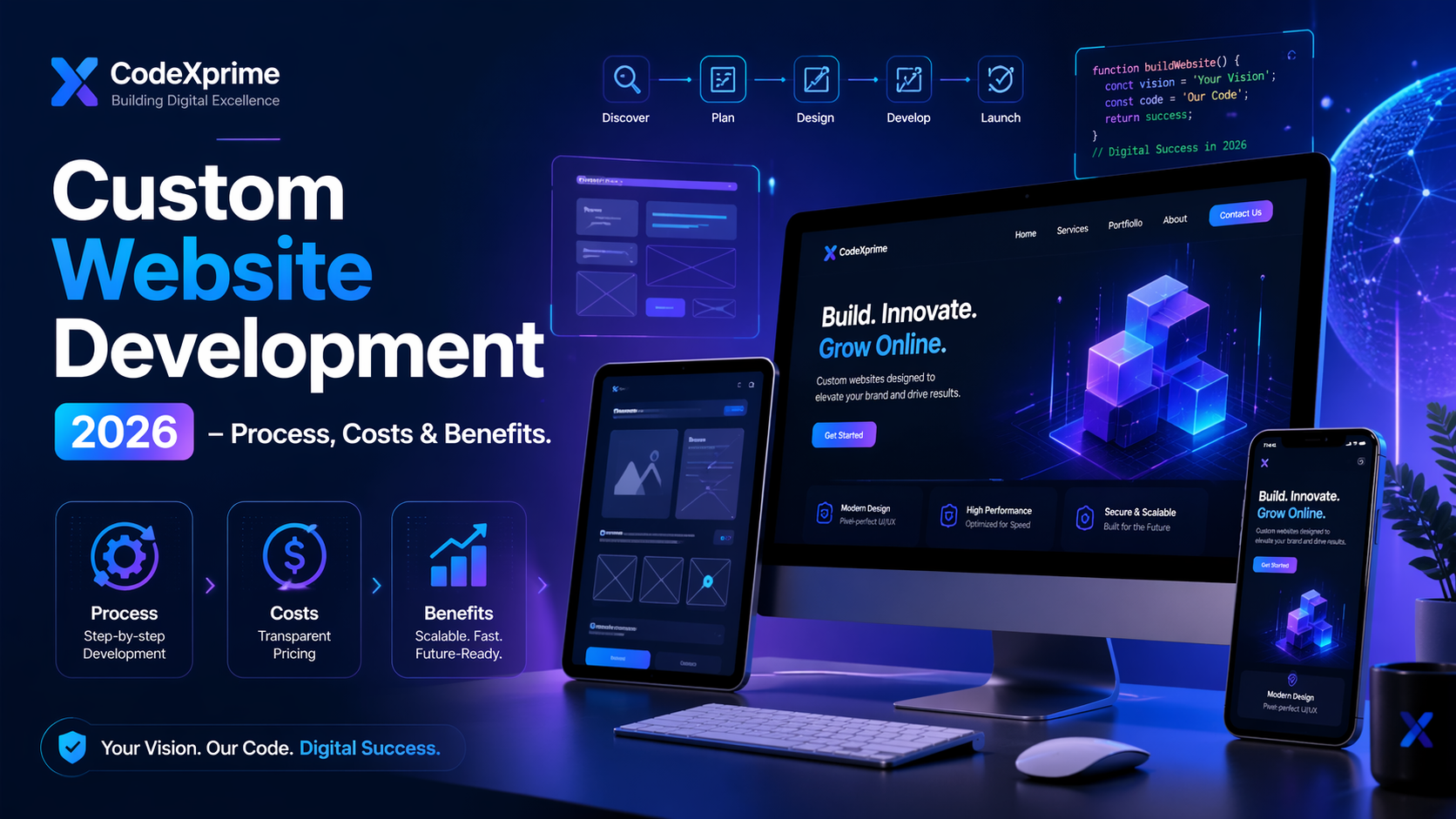
Custom website development is the process of building a website from scratch — designed and coded specifically for one business, with unique features, layout, and functionality that no template or page builder can replicate. It typically involves a dedicated design phase, front-end development using frameworks like React or Next.js, back-end development using Node.js, Laravel, or Django, and a database built around the specific data the business handles.
Think of it this way — a template website is a rented apartment where you can change the curtains. A custom website is a house built to your blueprint, where every room serves your exact needs.
Custom Website vs Template Website: The Real Difference
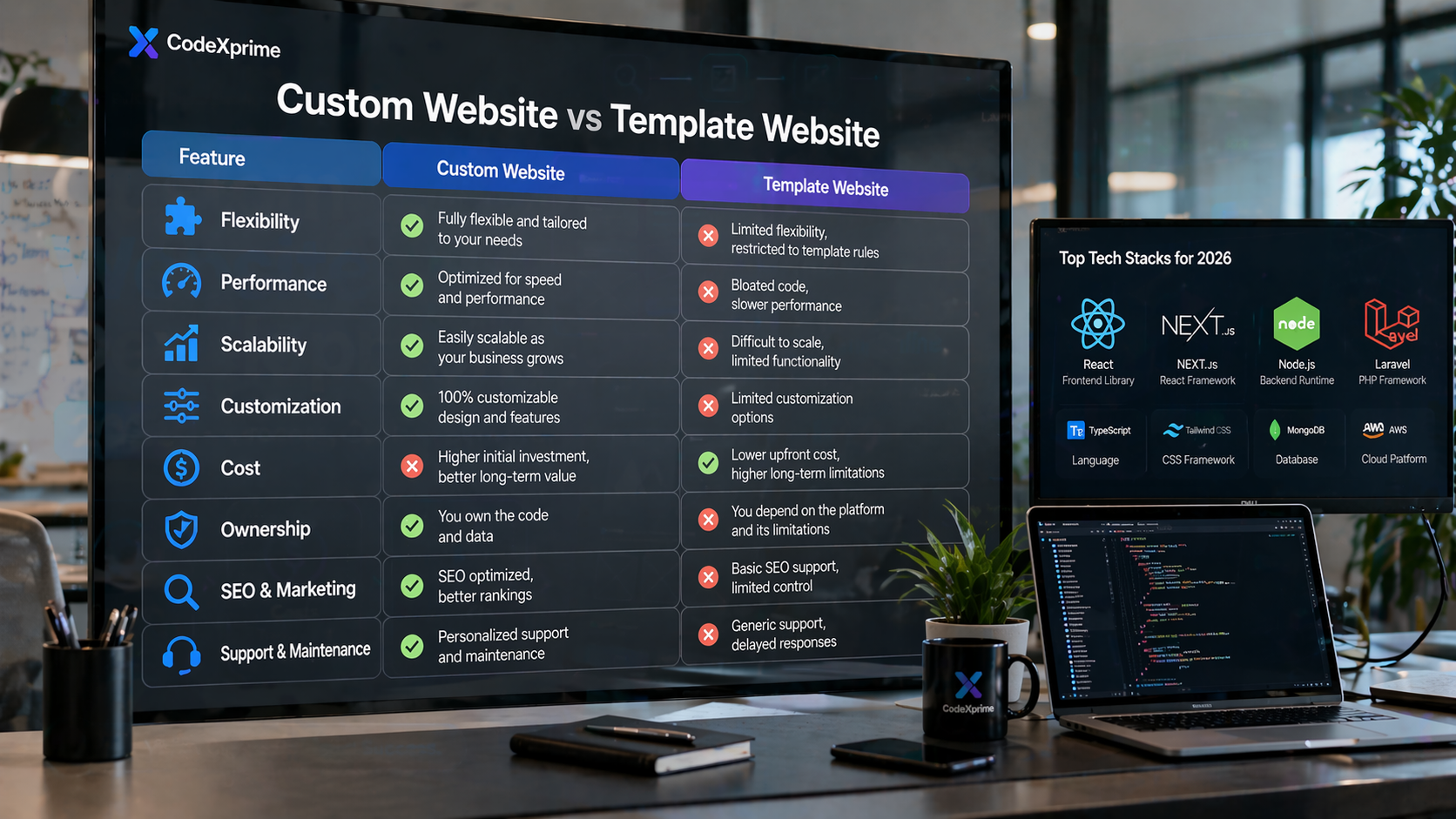
Before spending money, you need to understand what you are choosing between. Here is an honest comparison:
Factor | Template / Page Builder | Custom Website Design | Pre-made layouts, limited changes | Built from scratch for your brand Speed | Bloated code, slow loading | Lean code, optimized for performance SEO | Basic SEO, limited control | Full SEO architecture from day one Features | Plugin-dependent, what you see is what you get | Anything you need, built to spec Scalability | Hits limits as traffic grows | Scales with your business Cost (Initial) | Lower (Rs 5,000 – Rs 30,000) | Higher (Rs 50,000 – Rs 5,00,000+) Cost (Long-term) | Adds up with plugins, patches, rebuilds | Lower maintenance, fewer rebuilds Ownership | Platform-dependent | 100% yours
Template websites are perfectly fine for personal blogs, hobby sites, or businesses testing an idea with minimal investment. But the moment you need something a plugin does not offer, you hit a wall.
Why Custom Website Development Is Growing in 2026
Custom development is not just for enterprises anymore. Here is why more small and mid-size businesses are making the switch:
- AI Is Raising Customer Expectations
Customers are used to Amazon-level personalization. They expect your website to remember their preferences, suggest relevant products, and load in under two seconds. Template sites cannot deliver this without heavy modification — and heavy modification to a template defeats the purpose of using a template in the first place.
- Google Rewards Performance
Core Web Vitals are now a confirmed ranking factor. Custom websites built with modern frameworks like Next.js and optimized hosting consistently outperform template-heavy WordPress sites on Largest Contentful Paint, First Input Delay, and Cumulative Layout Shift — the three metrics Google cares about most.
- Cookie-Cutter Sites Are Invisible
There are over 835 million websites on the internet right now. If your site looks like 10,000 others using the same Elementor template, you are invisible. Custom design creates visual identity that customers remember, and that Google recognizes as unique content.
- Business Logic Has Gotten Complex
Dynamic pricing, multi-language content, role-based dashboards, API integrations with CRMs and ERPs, custom calculators, interactive tools — modern businesses need features that no plugin marketplace can handle cleanly. Custom web application development solves problems templates were never designed for.
- Security Expectations Are Non-Negotiable
In 2025 alone, over 30,000 WordPress sites were compromised through plugin vulnerabilities. Custom websites reduce attack surface because there is no third-party code you do not control. For businesses handling payments, personal data, or sensitive information, this matters.
When Do You Actually Need a Custom Website?
Not every business needs custom development. Here is an honest breakdown:
You Need Custom Website Development When:
Your business has unique workflows that templates cannot handle You need integrations with CRM, ERP, inventory, or proprietary systems Speed and performance are directly tied to revenue You need role-based access, custom dashboards, or user portals Your brand identity needs to stand out from competitors You are planning to scale and need architecture that grows with you Security requirements demand full code control
A Template Website Is Fine When:
You are testing an idea and need something live quickly Your budget is under Rs 30,000 You need a simple portfolio, blog, or brochure site You do not need custom features or third-party integrations You are comfortable with platform limitations
If you are not sure, start with a lean MVP. Our MVP development services help businesses validate ideas in 4-6 weeks without overcommitting on budget. If the MVP works, you scale into a full custom build with confidence.
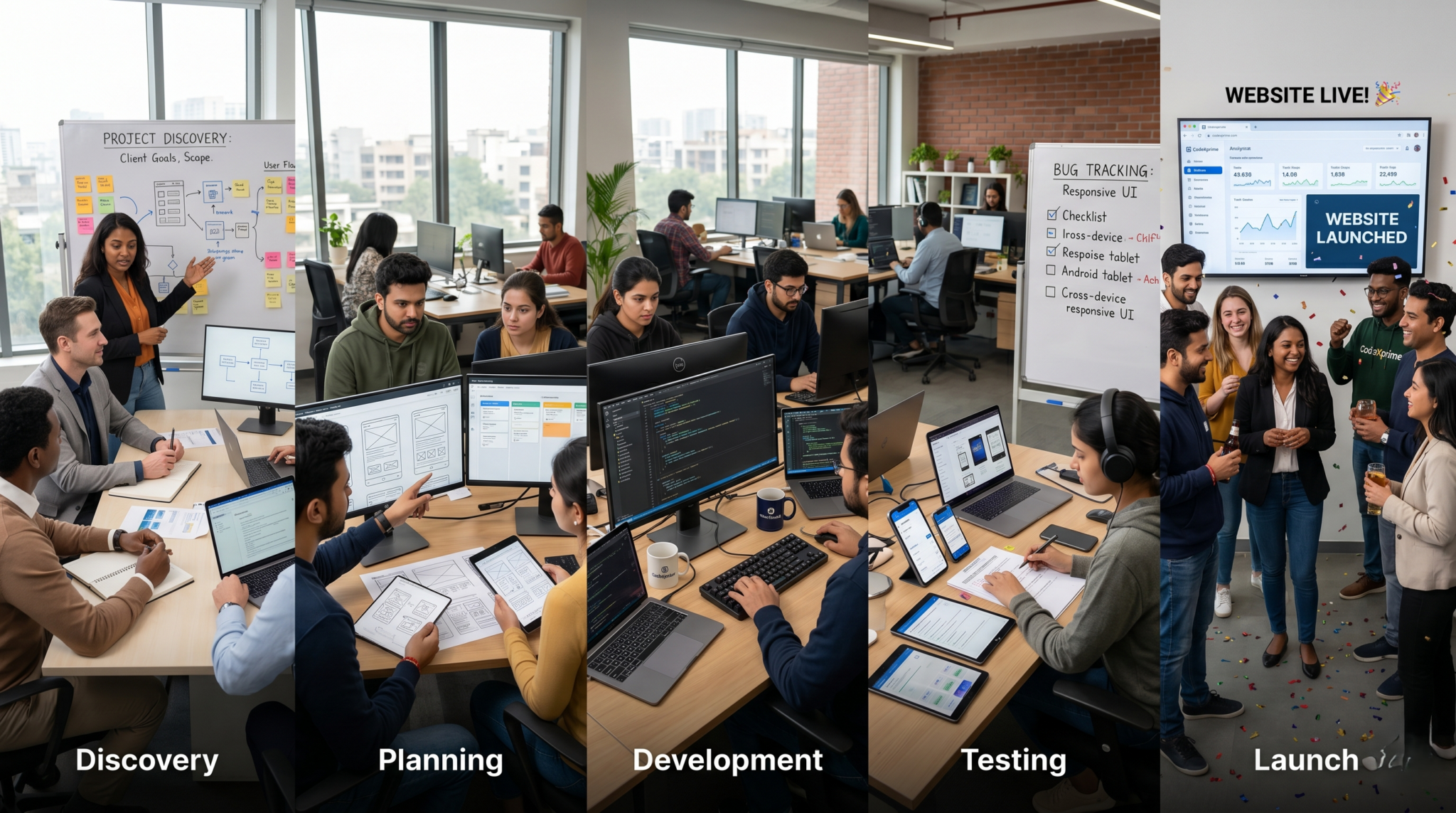
The Custom Website Development Process: Step by Step
Whether you hire CodeXprime or anyone else, knowing this process helps you ask the right questions and avoid getting cheated.
Step 1 — Discovery and Requirements (Week 1)
This is the foundation. A good developer spends significant time understanding your business before touching any code. Discovery covers your target audience and their behavior, the core problem your website solves, must-have features vs nice-to-have features, existing systems you need to integrate with such as CRM, payment, inventory or shipping, budget range and launch timeline, and competitor analysis to identify gaps and opportunities.
Output: A detailed project brief, sitemap, and feature specification document.
Step 2 — Wireframing and UX Design (Week 2)
Before anyone thinks about colors or fonts, wireframes map out where every element sits on every page. This is about user flow — how a visitor moves from landing on your homepage to completing the action you want, whether that is making a purchase, filling a form, or booking a call.
Good UX design at this stage prevents expensive redesigns later. Tools like Figma make it easy to visualize and approve layouts before development starts.
Step 3 — Visual Design (Week 2-3)
Now the wireframes get dressed. Colors, typography, imagery, animations, and brand elements come together into high-fidelity mockups. You see exactly what the final website will look like — on desktop, tablet, and mobile — before any code is written.
This is where professional web design services make the biggest visible difference. The gap between a professionally designed custom site and a DIY template site is obvious to every visitor.
Step 4 — Front-End Development (Week 3-5)
Approved designs are converted into real, working code. The front-end is everything the user sees and interacts with — responsive layouts, animations, interactive elements, forms, navigation, and micro-interactions.
Modern custom websites use frameworks like React, Next.js, or Vue.js for faster rendering, better SEO through server-side rendering, and smoother user experience compared to traditional HTML/CSS.
Step 5 — Back-End Development (Week 3-6)
The back-end is the engine. It handles data processing, user authentication, database management, API connections, email systems, and admin dashboards. Technologies depend on your project — Node.js and Express for JavaScript-based stacks, Laravel for PHP, Django for Python, or .NET for enterprise environments.
If your project includes a custom CMS, this is where the content management system is built — tailored to how your team actually creates and manages content, not how WordPress thinks you should.
Step 6 — Integration and API Work (Week 5-6)
Modern businesses rarely operate on one tool. Your website needs to talk to your payment gateway like Razorpay or Stripe, your CRM like HubSpot or Zoho, your email platform like Mailchimp or Brevo, your analytics stack, and potentially your inventory or ERP system.
Custom development means these integrations are built properly — not through clunky plugins that break with every update.
Step 7 — Testing and Quality Assurance (Week 6-7)
Every link, every form, every button, every edge case is tested. Professional QA includes cross-browser testing across Chrome, Safari, Firefox, and Edge. Mobile testing on real devices not just browser previews. Load testing to handle traffic spikes, security testing for vulnerabilities, payment gateway testing in sandbox mode, accessibility checks for compliance, and performance benchmarking against Core Web Vitals targets.
Step 8 — Launch, Monitoring, and Iteration (Week 7-8+)
Launch is not the finish line. It is the starting gun. The first 30 days after launch are critical for monitoring real user behavior, fixing unexpected issues, optimizing conversion paths based on actual data, and making adjustments based on Google Search Console data.
Technology Stack: What Gets Used in Custom Website Development
The technology behind your website affects its speed, security, scalability, and maintenance cost. Here is what professional developers use in 2026:
Front-End Technologies
React.js — Most popular front-end library, massive community, component-based architecture Next.js — React framework with server-side rendering, excellent for SEO and speed Vue.js — Lightweight alternative, great for interactive UIs Tailwind CSS — Utility-first CSS framework for rapid, consistent styling
Back-End Technologies
Node.js with Express — Fast, JavaScript-based, ideal for real-time applications Laravel (PHP) — Mature framework, excellent for content-heavy sites and APIs Django (Python) — Strong for data-heavy applications, built-in admin panel Custom CMS — When WordPress is too rigid and headless CMS is overkill
Databases
PostgreSQL — Robust, scalable, industry standard for complex queries MongoDB — Flexible document database, great for rapidly changing data structures MySQL — Reliable, widely supported, lower learning curve
Hosting and Infrastructure
AWS, Google Cloud, Vercel, and DigitalOcean are the go-to choices depending on budget and scale. For Indian businesses, AWS Mumbai region or Google Cloud Mumbai provides the lowest latency for domestic traffic.
How Much Does Custom Website Development Cost in India? (2026 Pricing)
Honest pricing — because vague answers help nobody:
Project Type | Cost Range | Timeline Landing Page / Single Page Site | Rs 15,000 – Rs 40,000 | 1-2 weeks Business Website (5-10 pages) | Rs 40,000 – Rs 1,20,000 | 3-7 weeks Custom Web Application | Rs 1,20,000 – Rs 5,00,000 | 6-12 weeks Custom Ecommerce Platform | Rs 85,000 – Rs 3,50,000+ | 8-16 weeks SaaS / Marketplace Platform | Rs 3,00,000 – Rs 15,00,000+ | 12-30 weeks Website Maintenance | Rs 3,000 – Rs 25,000/month | Ongoing
What affects the price: number of pages and unique layouts, complexity of features and integrations, design complexity from simple clean layouts to animation-rich branded experiences, back-end requirements and database complexity, third-party API integrations, and ongoing maintenance expectations.
Pro tip: If someone quotes you Rs 10,000 for a custom website, it is not custom. It is a template with changed colors. Real custom development takes real time, and real time costs real money. The savings show up in year two when you do not need to rebuild.
CodeXprime’s Custom Website Development Services
Now that you understand what custom development is and how it works, here is exactly what CodeXprime delivers:
What You Get With Every CodeXprime Project
Original design — no templates, no recycled layouts, no generic themes Mobile-first responsive build — tested on real devices, not just browser previews Fast page load — under 3 seconds, often under 2, optimized for Core Web Vitals SEO-ready architecture — clean URLs, proper heading hierarchy, schema markup, crawlable content Secure code — HTTPS, input validation, protection against common vulnerabilities Admin panel or custom CMS — so your team can manage content without calling a developer Third-party integrations — payment gateways, CRM, email marketing, analytics, APIs Google Analytics 4 and Meta Pixel setup — tracking from day one 30 days post-launch support — bugs, adjustments, and questions covered Full code ownership — everything we build belongs to you
- Custom Business Websites
Corporate sites, portfolios, service pages, and lead generation websites built to represent your brand professionally and convert visitors into inquiries. We design every page around your sales funnel — homepage to capture attention, service pages to build trust, case studies to prove results, and contact pages that make it easy to reach you.
Technology: React or Next.js front-end, Node.js or Laravel back-end, custom CMS for content management.
Best for: Service businesses, agencies, consultancies, professional firms.
- Custom Web Applications
When your business needs more than a website — dashboards, user portals, booking systems, calculators, internal tools, or any web-based software — we build custom web applications from scratch. These are not WordPress plugins stitched together. These are purpose-built applications with proper architecture, secure authentication, and scalable databases.
Technology: React or Vue.js front-end, Node.js with Express or Django back-end, PostgreSQL or MongoDB database.
Best for: SaaS startups, EdTech platforms, HealthTech solutions, internal business tools.
- Custom Ecommerce Development
When Shopify and WooCommerce templates cannot handle your product catalog, pricing logic, or customer experience requirements, we build ecommerce platforms from scratch. For standard ecommerce needs, our ecommerce website development services cover Shopify and WooCommerce projects. But when you need custom cart logic, B2B pricing tiers, multi-vendor support, or integration with existing inventory systems — custom development is the answer.
Technology: Next.js storefront, Node.js or Laravel API, Razorpay or Stripe integration, custom inventory management.
Best for: Niche ecommerce brands, B2B suppliers, marketplace founders, subscription businesses.
- Custom CMS Development
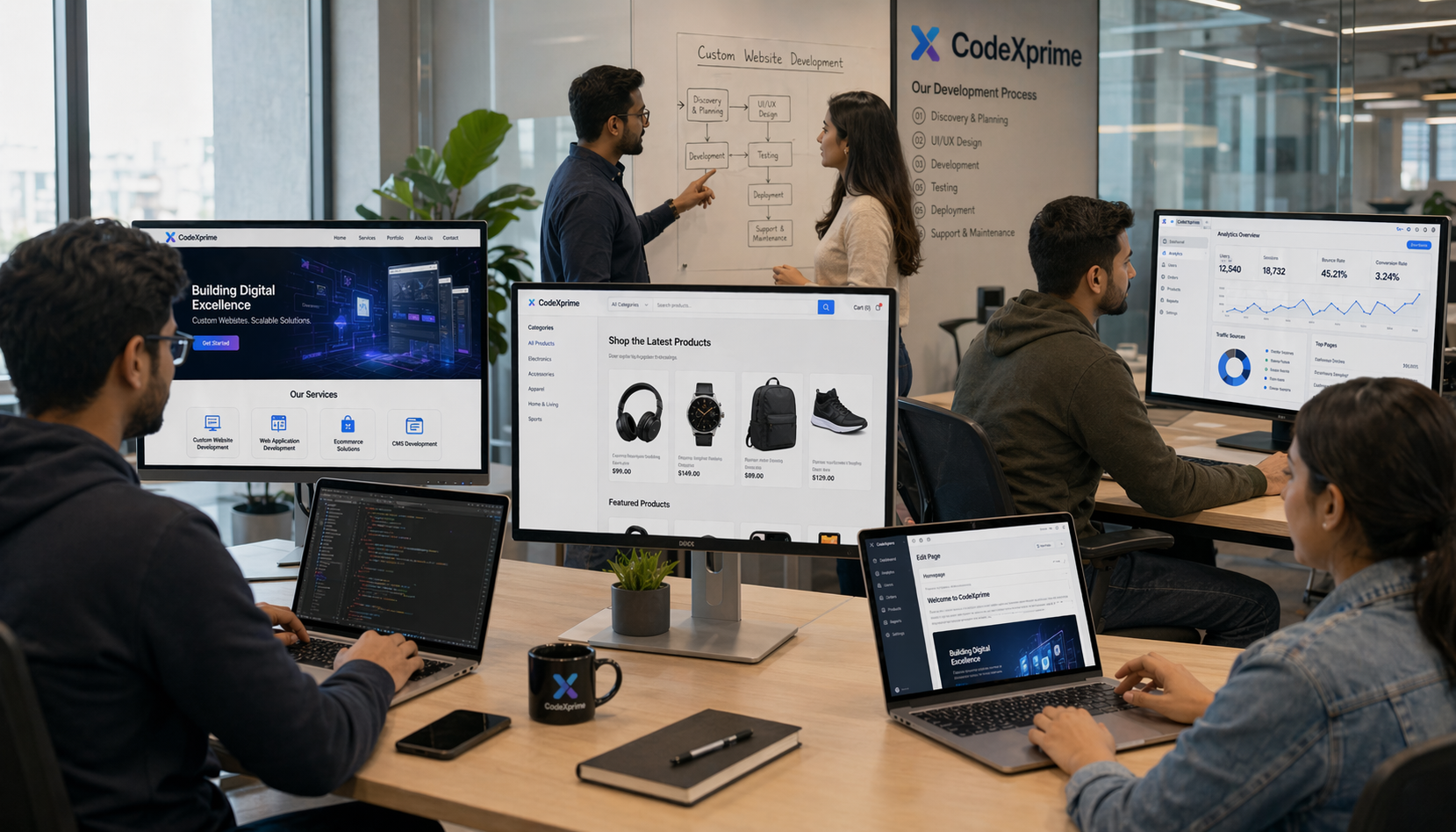
WordPress is not the only CMS in existence. When your content structure does not fit into posts and pages — when you need custom content types, role-based editing, approval workflows, or multi-site management — we build a CMS that fits your content, not the other way around.
Technology: Strapi, Sanity, or fully custom CMS built on Node.js or Laravel.
Best for: Media companies, multi-brand organizations, content-heavy businesses with complex workflows.
- Custom Landing Pages and Microsites
High-converting landing pages built for specific campaigns, product launches, or marketing funnels. These are not Unbounce templates — they are custom-coded pages optimized for speed, conversion, and SEO.
Technology: Next.js or static HTML/CSS, minimal JavaScript, sub-2-second load times.
Best for: Paid ad campaigns, product launches, event registrations, lead capture.
- API Development and Integration
Your website needs to communicate with other systems — payment gateways, CRMs, shipping providers, email platforms, SMS services, and custom databases. We build and integrate REST APIs and webhooks to connect everything smoothly.
Technology: Node.js, Express, RESTful API design, webhook configuration, OAuth2 authentication.
Best for: Businesses with multiple software tools, SaaS platforms, data-heavy operations.
- Website Redesign and Migration
If your current website is slow, outdated, or not converting, we redesign and rebuild without losing your existing SEO rankings or customer data. We handle proper 301 redirects, content migration, URL preservation, and Core Web Vitals optimization. Many businesses come to us after a bad experience with another developer. We fix what is broken and build what was missing.
Best for: Businesses stuck on outdated platforms, sites with poor performance, brands needing a visual refresh.
How Custom Website Development Supports SEO
A custom-built website gives you SEO advantages that templates simply cannot match:
Server-side rendering with Next.js means search engines see fully rendered content — no JavaScript rendering delays Clean, semantic HTML structure that Google’s crawlers understand perfectly Schema markup built into the code, not added through a plugin that might break Optimized Core Web Vitals because there is no bloated code from unused plugins and theme features Custom URL structures that match your keyword strategy exactly Internal linking architecture designed around your content strategy, not template limitations Lazy loading, image optimization, and code splitting built into the development process
If organic search is a significant traffic channel for your business, custom development pays for itself through better rankings and more consistent traffic over time. Combined with our SEO services in Delhi, your custom website starts competing in search results from launch day.
Common Mistakes to Avoid in Custom Website Development
After working on 150+ projects, these are the mistakes we see businesses make again and again:
- Skipping the discovery phase. Jumping straight into design without understanding your users leads to a beautiful website nobody uses. Discovery is not optional — it is the most important step.
- Choosing technology based on hype. Not every project needs React or Next.js. Sometimes Laravel with server-rendered pages is faster to build, easier to maintain, and perfectly adequate. Let the requirements drive the tech stack, not the developer’s resume.
- Underestimating content. A custom website with placeholder content is like a custom suit with no fabric. Budget time and effort for real copywriting, photography, and content creation before launch.
- Ignoring mobile from the start. Mobile-first is not just a design trend. Over 70 percent of website traffic in India comes from phones. If your custom site is designed desktop-first and adapted for mobile later, the mobile experience will always feel like an afterthought.
- No SEO architecture in the code. Clean URLs, proper heading hierarchy, structured data markup, fast load times, and crawlable content need to be built into the code — not added as a plugin after launch.
- Hiring based on price alone. The cheapest developer is almost never the cheapest option. A poorly built custom site costs more to fix than it cost to build. Check portfolios, ask for references, and verify they have experience with your type of project.
- No post-launch plan. Building a website without a plan for content updates, security patches, performance monitoring, and feature additions is like buying a car with no plan for fuel. Maintenance is not optional.
Real-World Use Cases for Custom Website Development
Custom development is not just for tech companies. Here are real scenarios where businesses benefit:
A Delhi-based fitness chain needed a booking system with class schedules, trainer profiles, membership management, and payment integration — no gym plugin could handle all of it cleanly
An education startup required a student portal with course access, progress tracking, certificate generation, and parent dashboards — all from one admin panel
A B2B manufacturer wanted a product catalog with 5,000+ SKUs, bulk pricing calculators, RFQ forms, and dealer login portals — standard ecommerce website development platforms could not manage the complexity
A real estate company needed property listings with map integration, virtual tours, EMI calculators, and lead routing to different agents based on location
A healthcare provider required secure data handling, appointment booking, teleconsultation integration, and medical record access — security and compliance made custom development mandatory
Why CodeXprime for Custom Website Development?
150+ Projects Across Industries
We have built custom websites for ecommerce brands, SaaS startups, educational institutions, healthcare providers, real estate companies, B2B manufacturers, and professional service firms. Each project adds to our understanding of what works and what does not. You benefit from every lesson we have learned.
Design and Development Under One Roof
At CodeXprime, our web design services and web development services teams sit together, collaborate daily, and work on the same project timeline. There is no gap between what the designer envisions and what the developer builds. The result is a website where design and functionality are inseparable.
Conversion-Driven Development
We do not build websites to look pretty in portfolios. Every layout decision, button placement, and interaction is based on one question — does this help the visitor take the action the business needs? Our clients typically see measurable improvement in lead generation and conversion rates after launching their custom website.
Local Roots, National Reach
We are based in Delhi NCR and proudly serve businesses in Dwarka, Uttam Nagar, Janakpuri, Tilak Nagar, and Dwarka Mor as a trusted web development company in Dwarka. But our client base extends across India and internationally. Whether you want in-person meetings or prefer video calls — we deliver the same quality either way.
Transparent Pricing and Process
Every quote comes with detailed line items — what is included, what costs extra, and why. You see a project timeline with milestones before signing anything. No surprise invoices. No vague estimates. No hidden charges three weeks into development.
Full Code Ownership
Everything we build belongs to you. Source code, design files, assets, documentation — all of it. You are never locked into our agency. If you want to hire a different team later, add features in-house, or switch hosting — you can. We build for your independence, not your dependency.
Industries We Serve
Our custom website development services have delivered results for:
SaaS and Technology — product websites, dashboards, customer portals, documentation sites Ecommerce and D2C — custom storefronts, B2B platforms, subscription businesses, marketplace platforms Education and EdTech — student portals, course platforms, LMS systems, school websites Healthcare — appointment booking, teleconsultation platforms, patient portals, clinic management Real Estate — property listings, map integrations, EMI calculators, lead management Professional Services — law firms, accounting practices, consulting agencies, architecture studios Manufacturing and B2B — product catalogs, RFQ systems, dealer portals, inventory management Media and Publishing — content platforms, multi-author sites, ad-supported models, subscription walls Nonprofits and NGOs — donor portals, campaign pages, volunteer management, event platforms Startups — MVPs, validation sites, landing pages, pitch decks turned into products
Red Flags When Hiring Custom Website Developers
Before you hire anyone — including us — watch for these warning signs:
- They quote without asking about your business. A real developer asks 20+ questions before sending pricing. If someone quotes in five minutes, they are selling templates, not custom work.
- They cannot show similar projects. If they have never built what you need, your project is their experiment. You pay for their learning curve.
- They do not mention SEO or performance. A beautiful website that loads in 8 seconds and cannot be found on Google is expensive decoration.
- They want full payment upfront. Professional agencies work in milestones — pay as you go, review at each stage.
- They do not give code ownership. If you do not own your code, you are renting your website. That gives the developer permanent leverage over your business.
- They disappear after launch. Ask for maintenance plan details before signing. Post-launch support separates professionals from hit-and-run developers.
- They outsource your project without telling you. Ask directly — is the work done in-house or subcontracted? Your answer affects quality, communication, and accountability.
Trust Signals — Why Businesses Choose CodeXprime
150+ custom website projects delivered across India and abroad Average client retention of 2+ years — clients stay because the work keeps delivering results 30+ active maintenance clients trusting us with their live websites monthly 5-star ratings across Google and professional platforms Direct founder access — you talk to decision-makers, not account managers who relay messages Weekly progress updates with staging site access — you see your project grow in real time Zero outsourcing — every project handled by our in-house team in Delhi Serving Dwarka, Uttam Nagar, Janakpuri, Tilak Nagar, Dwarka Mor, and Pan India
What Comes After Building Your Custom Website?
A custom website is a living product, not a one-time deliverable. Here is what happens after launch:
Content updates — regular blog posts, case studies, and fresh pages to support organic search growth Performance monitoring — tracking Core Web Vitals, uptime, and server response times monthly Security patches — keeping frameworks and dependencies updated to close vulnerabilities Feature additions — new tools, integrations, or pages as your business evolves Conversion optimization — using heatmaps, analytics, and A/B testing to improve results SEO growth — building topical authority through content clusters and technical optimization
The best websites improve continuously. Building once and forgetting is a recipe for a site that stops working for your business within 12 months.
Ready to Build a Website That Works as Hard as You Do?
Your competitors are launching new websites. Every month you run on an outdated template is revenue going to someone with a better online presence.
Here is what happens when you contact us:
- Within 24 hours, we schedule a free 30-minute consultation
- We understand your business, your customers, and your specific needs
- Within 2 working days, you receive a detailed proposal with timeline and pricing
- If you approve, development starts within one week
No pushy sales calls. No copy-paste proposals. Just honest answers and a clear plan built around your business.
Call now: +91 935 473 4436 Email: codexprime00@gmail.com Visit: codexprime.in
Need to validate your idea first? Our MVP development services help you test market demand in 4-6 weeks before committing to a full build.
Want ecommerce specifically? Check our ecommerce website development guide or explore our ecommerce website development services for complete online store solutions.
Looking for a reliable website development company in Delhi? We are right here — and we have been for 150+ projects.
Frequently Asked Questions
What is custom website development?
Custom website development means building a website from scratch with unique design, features, and code tailored to a specific business. Unlike template websites, every element is created specifically for your needs — from the front-end layout to the back-end logic and database structure.
How much does custom website development cost in India?
In 2026, custom website development in India ranges from Rs 15,000 for a landing page to Rs 15,00,000 or more for complex SaaS or marketplace platforms. Most small and mid-size business websites cost between Rs 45,000 and Rs 1,20,000. At CodeXprime, we provide detailed pricing in your proposal so there are no surprises.
How long does it take to build a custom website?
Custom landing pages take 1-2 weeks. Business websites take 3-7 weeks. Custom web applications take 6-12 weeks. Complex platforms with advanced features can take 12-30 weeks. Timeline depends on features, integrations, design complexity, and content readiness.
What is the difference between custom development and WordPress?
WordPress uses pre-built themes and plugins that you configure. Custom development writes original code for your specific needs. WordPress is faster and cheaper to launch but limited by available plugins. Custom development takes longer but gives you complete control over features, speed, and security.
Is custom website development worth the investment?
Yes, when your business needs unique features, better performance, stronger security, or a distinctive brand presence. Custom sites have lower long-term costs because they do not need constant plugin purchases, theme updates, and eventual rebuilds that template sites require.
Can a custom website be SEO-friendly?
Custom websites are often more SEO-friendly than template sites because developers can build clean code, fast load times, proper schema markup, and optimized URL structures directly into the architecture. There is no bloated plugin code slowing things down or conflicting with search engine requirements.
Will I own the code after the project is complete?
Yes. Every CodeXprime project includes full ownership of source code, design files, and all assets. You are never locked into our agency. You can hire other developers, move hosting, or modify anything freely.
Do you offer maintenance after launch?
Yes. Maintenance plans start at Rs 3,000 per month and include daily backups, security monitoring, framework updates, speed optimization, bug fixes, and monthly performance reports. Larger plans include feature additions and priority support.
Can you redesign my existing website without losing rankings?
Yes. Our redesign process preserves existing SEO through proper URL handling, 301 redirects where needed, content hierarchy preservation, and Core Web Vitals improvement. Most clients see ranking improvements, not drops, after we redesign their sites.
Do you work with businesses outside Delhi?
Yes. While we are based in Delhi NCR and serve clients locally in Dwarka, Uttam Nagar, Janakpuri, Tilak Nagar, and Dwarka Mor, we work with businesses across India and internationally through video calls, email, and project management tools.
Custom websites range from ₹2 Lakh to ₹15 Lakh+. Read the full pricing breakdown here.
How is CodeXprime different from other web development companies?
Three things set us apart. First, we build truly custom websites — no templates with changed colors. Second, we handle design, development, and SEO under one roof so nothing gets lost in translation. Third, we focus on conversion and business results, not just looks. Our 150 plus project portfolio and 2-year average client retention rate back this up.