You have an idea that keeps you up at night. You have explained it to friends, sketched it on napkins, maybe even made a pitch deck. But here is the problem — turning that idea into a real working product feels overwhelming, expensive, and risky.
What if you could test your idea with real users in 4 to 12 weeks — without spending lakhs on a full product that nobody might want?
That is exactly what MVP development services do. And at CodeXprime, it is exactly what we specialize in.
We have delivered 50+ MVPs for startups across India. Web apps, mobile apps, SaaS platforms, marketplaces — every one of them built with one goal: get your product to market fast, validate it with real users, and only then invest more.
No bloated timelines. No six-figure budgets. No building the wrong thing for a year in stealth mode. Just a working product that real people can use — built by a team that understands startups.
What Are MVP Development Services?
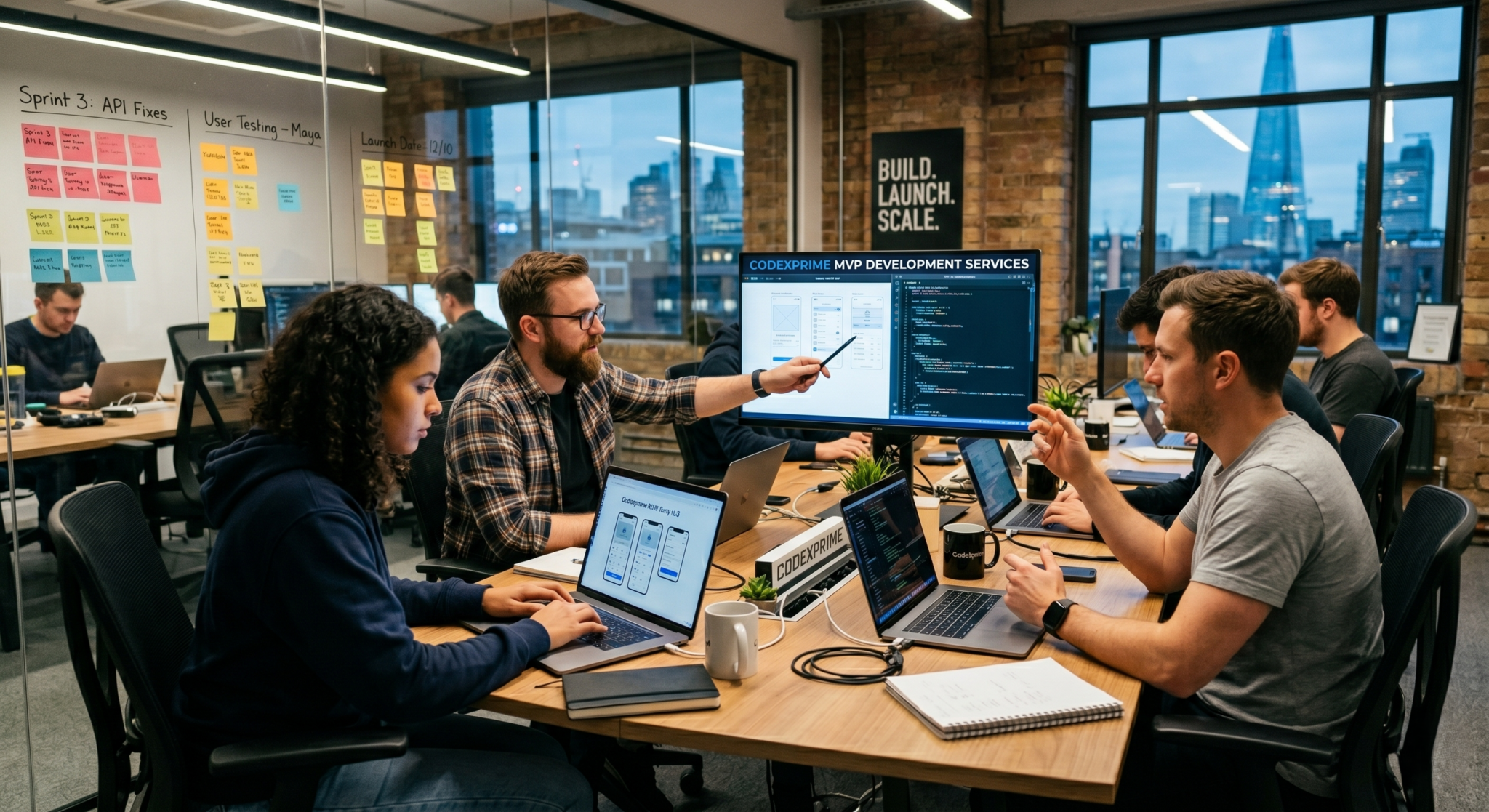
MVP development services help startups build a Minimum Viable Product — the simplest working version of a product that solves one core problem for real users. The goal is to validate your business idea with minimum investment before building the full product. MVP development typically includes idea validation, UI/UX design, core feature development, testing, launch, and user feedback collection. It takes 4 to 12 weeks and costs significantly less than full product development.
In simple words — MVP development services turn your idea into a real product that real people can use, without burning through your entire budget.
Why Every Startup Needs an MVP Before Building the Full Product
The startup graveyard is full of products that were built perfectly but solved problems nobody actually had. According to CB Insights, 35 percent of startups fail because there is no market need. Not because the code was bad. Not because the design was ugly. Because they built the wrong thing.
Here is what building an MVP does for you:
Validates your idea with real users before you invest heavily. If people use your MVP and come back, you have product-market fit. If they don’t, you pivot early and cheap.
Saves 60 to 80 percent of development costs. A full product costs 5 to 10 times more than an MVP. If the idea doesn’t work, you lose weeks and thousands instead of months and lakhs.
Attracts investors and co-founders. Investors don’t fund ideas. They fund traction. An MVP with 100 active users is worth more than a 50-slide pitch deck.
Gets you to market faster. In 2026, speed matters more than perfection. The startup that ships first and iterates wins over the one that builds for a year in stealth mode.
Gives you real data to make decisions. Instead of guessing what users want, you watch what they actually do. Every click, every drop-off, every feature request becomes your roadmap.
MVP vs Full Product — Understanding the Difference
Features — MVP has 1 to 3 core features only. Full product has the complete feature set.
Timeline — MVP takes 4 to 12 weeks. Full product takes 6 to 18 months.
Cost — MVP costs ₹50,000 to ₹3,00,000. Full product costs ₹5,00,000 to ₹50,00,000 or more.
Goal — MVP validates the idea and gets feedback. Full product scales, monetizes, and grows.
Design — MVP is clean but functional. Full product is polished and branded.
Users — MVP targets early adopters (50 to 500 users). Full product targets the general market (1000 or more).
Risk — MVP carries low risk with small investment. Full product carries high risk with large investment.
Our MVP Development Services
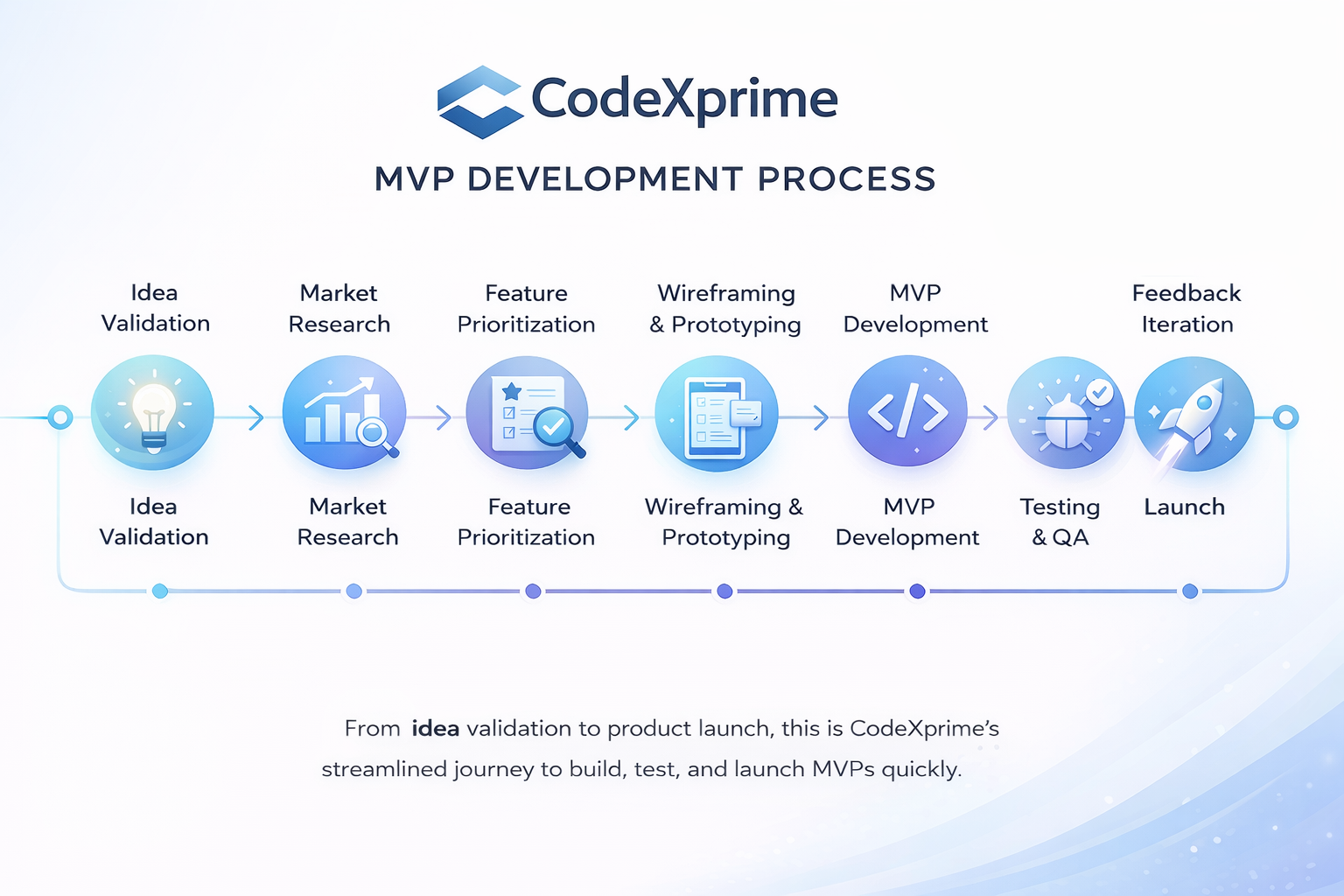
1. Web App MVP Development
For startups building browser-based products — dashboards, SaaS tools, web portals, and internal platforms. We use React or Next.js for the frontend and Node.js or Python for the backend, deployed on AWS or Vercel for reliability.
Best for: SaaS startups, B2B tools, admin dashboards, content platforms
2. Mobile App MVP Development
Cross-platform mobile apps using React Native or Flutter. One codebase delivers both iOS and Android apps, cutting development time and cost by 40 to 60 percent compared to building native apps separately.
Best for: Consumer apps, on-demand services, social platforms, fitness and health apps
3. SaaS MVP Development
Subscription-based software products with user authentication, role management, billing integration with Stripe or Razorpay recurring payments, and usage analytics. We build SaaS MVPs that are investor-ready from day one.
Best for: B2B software, HR tools, project management, CRM alternatives, niche industry tools
4. Marketplace MVP Development
Two-sided or multi-sided marketplace platforms connecting buyers with sellers, service providers with customers, or freelancers with businesses. Includes vendor onboarding, commission management, and payment splitting.
Best for: Service marketplaces, B2B procurement, freelancer platforms, rental marketplaces
5. Ecommerce MVP Development
For D2C brands testing a product line before building a full ecommerce website development setup. Lean product catalogs, simple checkout, and payment integration — everything you need to start selling and validating demand.
Best for: New D2C brands, subscription boxes, digital product sellers, niche retailers
6. AI-Powered MVP Development
MVPs that integrate artificial intelligence — chatbots, recommendation engines, content generation, image recognition, or predictive analytics. We integrate OpenAI, Claude, Gemini, and custom ML models into your product.
Best for: AI-first startups, intelligent automation tools, content platforms, data analysis products
7. No-Code MVP Development
For founders who need to validate fast with minimal investment. We build functional MVPs using Bubble, Webflow, Airtable, and Zapier — no code required. Perfect for testing before investing in custom development.
Best for: Non-technical founders, idea validation, budget-conscious startups
What You Get With Every CodeXprime MVP Project
Free idea validation session (30 minutes) — we tell you honestly if your idea needs an MVP or something else
Feature prioritization workshop — we help you cut to the 1 to 3 features that actually matter
Mobile-first UI/UX design in Figma — clean, professional, conversion-focused
Production-ready code — built to scale, not throwaway prototype code
Payment gateway integration — Razorpay, Stripe, Cashfree ready from day one
Analytics setup — Google Analytics 4, Mixpanel, or PostHog for tracking user behavior
30 days post-launch support — bug fixes, monitoring, and iteration support included
Full code ownership — everything we build belongs to you. No lock-in, no hostage situations
The 7-Step MVP Development Process (How It Actually Works)
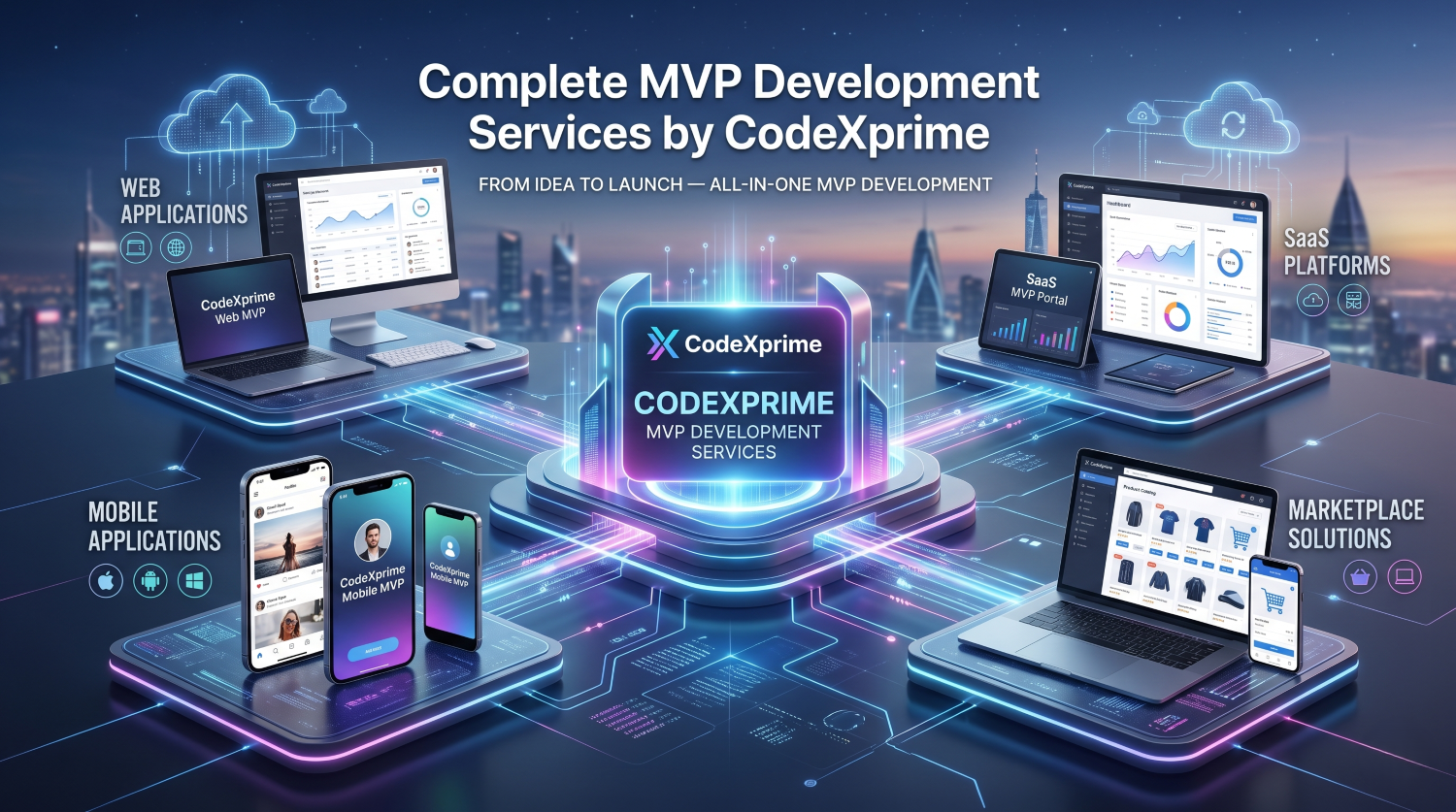
Step 1 — Idea Validation and Market Research (Week 1)
Before writing a single line of code, you need honest answers to three questions. Does this problem actually exist? Are people actively looking for a solution? Will they pay for it?
This involves competitor analysis, target audience research, keyword demand analysis, and talking to 10 to 20 potential users. If you skip this step, everything that follows is a gamble. Professional MVP development services always start here because building the wrong thing is the most expensive mistake a startup can make.
Step 2 — Define Core Features (Week 1)
An MVP is not a prototype with 50 features. It is the one thing your product does better than anything else. The rule is simple — if a feature is not essential to solving the core problem, it does not go in the MVP.
Example: If you are building a food delivery app MVP, your core features are browse restaurants, add to cart, checkout, and track order. Features like loyalty points, referral programs, and restaurant analytics come later.
Step 3 — UI/UX Design (Week 2 to 3)
Your MVP needs to look professional enough that users trust it, but not so polished that you spend 4 weeks on design alone. The best approach is mobile-first wireframes in Figma, followed by a clean minimal UI that focuses on usability.
Good web design services make a measurable difference here. A confusing interface kills MVPs faster than missing features.
Step 4 — Technology Stack Selection (Week 2)
The right tech stack for an MVP prioritizes speed of development, cost efficiency, and scalability potential. Here are the most common choices in 2026:
Web Apps: React or Next.js frontend with Node.js or Python Django backend and PostgreSQL or MongoDB database
Mobile Apps: React Native or Flutter for cross-platform — one codebase, both iOS and Android
SaaS Products: Next.js with Supabase or Firebase for rapid development with built-in auth and database
Marketplace MVPs: Laravel or Node.js backend with React frontend, Razorpay for payments, Cloudinary for media
No-Code or Low-Code: Bubble, Webflow, or Airtable for non-technical founders wanting to test ideas before investing in custom code
Step 5 — Development (Week 3 to 8)
This is where your MVP gets built. Development happens in 1 to 2 week sprints with regular check-ins. Each sprint delivers working features you can see and test — not just progress reports.
A good MVP development company keeps you involved throughout. You should be testing features as they are built, not seeing the product for the first time at launch.
Step 6 — Testing and Quality Assurance (Week 8 to 10)
Every button, form, payment flow, and edge case gets tested. This includes cross-browser testing, mobile responsiveness on real devices, payment gateway testing in sandbox mode, security testing, and performance testing. The goal is zero critical bugs at launch.
Step 7 — Launch, Measure, Iterate (Week 10 to 12)
Your MVP goes live — but launch is not the finish line. It is the starting point. The first 30 days are about watching real users interact with your product.
Key metrics to track: daily active users, feature usage rates, conversion rates, user retention (do they come back?), and Net Promoter Score. This data tells you what to build next, what to fix, and whether to scale or pivot.
Types of MVPs — Which One Fits Your Startup?
Landing Page MVP
Cost: ₹5,000 to ₹20,000 | Timeline: 1 to 3 days
A single page describing your product with a sign-up form. Measures demand before building anything. If 500 people visit and 50 sign up, there is interest. If nobody signs up, save your development budget.
Concierge MVP
Cost: ₹10,000 to ₹50,000 | Timeline: 1 to 2 weeks
You manually deliver the service your product promises. Example: Instead of building an automated meal planning app, you personally create meal plans for 20 users. This validates whether people actually want the service before you automate it.
No-Code MVP
Cost: ₹15,000 to ₹75,000 | Timeline: 2 to 4 weeks
Built using tools like Bubble, Webflow, Airtable, and Zapier without writing code. Works well for simple workflows and marketplace concepts. Limited in customization but fast to build and modify.
Single-Feature MVP
Cost: ₹50,000 to ₹2,00,000 | Timeline: 4 to 8 weeks
A coded product that does one thing exceptionally well. This is the most common MVP type for funded startups. Built with production-ready code that can scale.
Full MVP (Coded Product)
Cost: ₹1,50,000 to ₹4,00,000 | Timeline: 8 to 12 weeks
A complete working product with 3 to 5 core features, user authentication, payment integration, and admin dashboard. This is what most people mean when they say MVP development services.

How Much Do MVP Development Services Cost in India?
Realistic pricing — no fluff:
Landing Page MVP — ₹5,000 to ₹20,000 — 1 to 3 days
No-Code MVP — ₹15,000 to ₹75,000 — 2 to 4 weeks
Standard MVP (Single Feature) — ₹50,000 to ₹2,00,000 — 4 to 8 weeks
Full Coded MVP — ₹1,50,000 to ₹4,00,000 — 8 to 12 weeks
Complex MVP (Marketplace or SaaS) — ₹3,00,000 to ₹8,00,000+ — 12 to 20 weeks
Monthly Maintenance — ₹3,000 to ₹20,000 per month — Ongoing
What affects the cost: number of features, design complexity, platform (web vs mobile vs both), third-party integrations, and payment gateway setup. Always ask for a detailed feature-based quote, not a vague estimate.
Every CodeXprime project includes: free discovery call, detailed written proposal, weekly progress updates, 30 days post-launch support, and full source code ownership.
Building an MVP? See how the MVP approach can reduce your website development cost in Delhi.
MVP Development Trends in 2026
AI-powered MVPs are becoming standard. Startups are integrating OpenAI, Claude, and Gemini APIs to build intelligent features in weeks that would have taken months to code manually.
No-code tools are getting powerful enough for real products. Tools like Bubble and FlutterFlow now support complex logic, API integrations, and even native mobile apps.
Cross-platform frameworks like React Native and Flutter mean you can launch on web, iOS, and Android from one codebase — cutting MVP costs by 40 to 60 percent.
Backend-as-a-Service (Supabase, Firebase, Appwrite) eliminates the need to build backend infrastructure from scratch, saving 3 to 4 weeks of development time.
Speed of iteration matters more than ever. The best MVPs now launch in 4 to 6 weeks, get feedback in 2 weeks, and ship the improved version 2 weeks after that.
Common Mistakes That Kill Startup MVPs
1. Building too many features. The biggest MVP killer. Founders add “just one more feature” until the MVP becomes a full product that takes 6 months and costs 5 times the budget. Ruthlessly cut to 1 to 3 core features.
2. Skipping user research. Building based on assumptions instead of conversations with real potential users. Talk to 15 to 20 people before spending a single rupee on development.
3. Choosing the wrong tech stack. Using complex enterprise technology for a simple MVP. You do not need Kubernetes and microservices for your first 100 users. Keep it simple and scalable.
4. Ignoring mobile users. Over 70 percent of Indian internet users are mobile-first. If your MVP does not work perfectly on a ₹10,000 Android phone, you are ignoring your biggest audience.
5. No feedback loop. Launching an MVP and then waiting passively for feedback. Build in analytics, feedback forms, and schedule user interviews from day one.
6. Hiring the cheapest developer. A ₹15,000 MVP from a freelancer on Fiverr usually costs ₹1,50,000 to fix later. Invest in quality MVP development services from day one.
7. Perfectionism. Spending 3 weeks on a logo and 2 weeks on the perfect shade of blue. Your MVP needs to work well, not look like a Fortune 500 brand. Polish comes after validation.
8. No go-to-market plan. Building an MVP without a plan to get users. The best MVP in the world fails if nobody knows it exists. Plan your first 100 users before launch.
Who Needs MVP Development Services?
First-time founders validating a business idea before full investment
Funded startups building their first product for investor demos
Established businesses testing new product lines or digital services
SaaS founders building subscription-based software
Marketplace founders connecting buyers and sellers
D2C brands building custom ecommerce experiences beyond Shopify templates
Healthcare, edtech, fintech startups with regulatory-specific needs
Non-technical founders who have an idea but no coding skills
If you already have a validated product and need to scale with an ecommerce website development setup, that is a different service. But if you are at the idea stage, MVP first.
Industries We Build MVPs For
Fintech — Payment apps, lending platforms, expense trackers
Edtech — Learning platforms, course marketplaces, tutoring apps
Healthcare — Telemedicine apps, appointment booking, health trackers
Ecommerce and D2C — Product launch stores, subscription boxes, digital goods
SaaS and B2B — CRM tools, HR software, project management, analytics
On-Demand Services — Delivery apps, service booking, freelancer platforms
Social and Community — Niche social networks, community platforms, forums
AI and ML Products — Chatbots, recommendation engines, content generators
Why Startups Choose CodeXprime for MVP Development
50+ MVPs Delivered Across Industries
From fintech to foodtech, edtech to ecommerce — we have built MVPs for startups at every stage. Each project teaches us what works and what wastes time. Every new client benefits from that accumulated experience.
Design + Development Under One Roof
Our web design services and web development services teams sit together. No handoff gaps, no “the designer said one thing but the developer built another” situations. What you approve in Figma is what you get at launch.
Startup-Friendly Process
We understand startup budgets, timelines, and pressure. We work in weekly sprints with transparent communication. You see progress every week, not just at the end. And if priorities change mid-project, we adapt without drama.
Production-Ready Code, Not Throwaway Prototypes
Some agencies build MVPs with duct tape code that falls apart when you try to scale. We write clean, documented, scalable code from day one. When your MVP validates and you are ready to add features, we build on what exists — no rebuild required.
Transparent Pricing, No Scope Creep Surprises
Every quote is feature-based and detailed. You know exactly what you are paying for, what is included, and what would cost extra. No surprise invoices, no hidden fees.
Post-Launch Support and Growth
Launch is where most agencies disappear. We stay. 30 days of free bug fixes and support are included with every project. After that, affordable maintenance plans keep your MVP running while you focus on growth.
Local Roots, Professional Standards
We are based in Delhi NCR and have served businesses across Dwarka, Uttam Nagar, Janakpuri, Tilak Nagar, and Dwarka Mor. We also work with startups across India and internationally. Local presence, international quality.
Our MVP Development Process
Step 1 — Free Discovery Call (Day 1): We listen to your idea, understand your target users, and assess whether an MVP is the right approach. Sometimes we recommend a landing page test first. Sometimes we suggest going straight to a full MVP. We give honest advice, not a sales pitch.
Step 2 — Feature Workshop and Quote (Day 2 to 4): Together, we define the absolute minimum features your MVP needs. You receive a detailed proposal with feature list, tech stack recommendation, timeline, and transparent pricing.
Step 3 — Design Sprint (Week 1 to 2): Wireframes and UI designs in Figma. Mobile-first, user-focused, conversion-optimized. You approve every screen before development begins.
Step 4 — Development Sprints (Week 2 to 8): Weekly sprints with working demos. You can test features as they are built, not just at the end. Regular check-ins keep you in the loop.
Step 5 — Testing and QA (Week 8 to 10): Rigorous testing across devices, browsers, and real-world scenarios. Payment flow testing, security checks, performance optimization.
Step 6 — Launch (Week 10 to 12): Your MVP goes live. We set up analytics, monitoring, and help with your initial user acquisition strategy.
Step 7 — Post-Launch Support (30 Days): Bug fixes, performance monitoring, and iteration support. We help you interpret user data and plan your next development sprint.
Red Flags When Hiring MVP Developers
Before you sign with any agency, watch for these warning signs:
They quote without understanding your idea. A real MVP agency asks 20 plus questions before giving a price. If they quote in 5 minutes, run.
They promise everything in 2 weeks. A quality coded MVP takes 4 to 12 weeks minimum. Anyone promising faster is cutting corners you will pay for later.
No portfolio of startup MVPs. Building websites and building MVPs are different skills. Ask to see actual MVPs they have built and launched.
They don’t discuss post-launch. An MVP without a plan for what happens after launch is just a project, not a startup. Good agencies plan for iteration from day one.
Full payment upfront. Trustworthy agencies work in milestones. Never pay 100 percent before seeing a working product.
They don’t give code ownership. You should own everything. If an agency holds your code hostage, they are not your partner — they are your landlord.
Trust Signals — Why Startups Pick CodeXprime
50+ MVPs delivered for startups across India and abroad
4 to 12 week delivery timelines — consistently met
Full source code ownership on every project
Design and development in-house — no outsourcing
Direct founder access — talk to decision-makers, not account managers
Transparent communication with weekly progress demos
Post-launch support included — we don’t disappear after delivery
Based in Delhi NCR — serving pan India and international clients
Ready to Build Your MVP?
Your competitors are shipping products while you are still planning. Every week you wait is a week someone else gets closer to making your idea their reality.
Here is what happens when you contact us today:
Within 24 hours — we schedule a free 30-minute discovery call
Within 3 working days — you receive a detailed proposal with features, timeline, and pricing
Within 1 week — if you approve, development begins
No pushy sales. No copy-paste quotes. Just honest answers and a clear plan for your startup.
Call: +91 935 473 4436 Email: codexprime00@gmail.com Visit: codexprime.in Serving: Delhi NCR + Pan India + International clients
Whether you are a solo founder with a napkin idea or a funded startup ready to launch — our MVP development services are built around your goals, your timeline, and your budget.
Already have a validated product and ready to scale? Check out our ecommerce website development services or web development services for your next phase of growth.
Frequently Asked Questions
1. What are MVP development services? MVP development services help startups build a Minimum Viable Product — the simplest working version of a product that solves one core problem. It includes idea validation, design, development, testing, and launch support. The goal is to test your idea with real users before investing in full product development.
2. How much does it cost to build an MVP in India? MVP development costs in India range from ₹5,000 for a landing page MVP to ₹8,00,000 or more for complex marketplace or SaaS MVPs. Most startup MVPs cost between ₹50,000 and ₹3,00,000. Final cost depends on features, platform, and design complexity.
3. How long does it take to build an MVP? A landing page MVP takes 1 to 3 days. No-code MVPs take 2 to 4 weeks. Single-feature coded MVPs take 4 to 8 weeks. Full coded MVPs with 3 to 5 features take 8 to 12 weeks. Complex marketplace or SaaS MVPs take 12 to 20 weeks.
4. What is the difference between an MVP and a prototype? A prototype is a visual mockup or clickable demo — it looks like a product but does not work. An MVP is a real working product with limited features that actual users can use. Prototypes test design. MVPs test the entire business idea.
5. Should I use no-code tools or custom development for my MVP? Use no-code tools like Bubble or Webflow if your idea is simple, your budget is under ₹75,000, and you need to test quickly. Use custom development if you need complex features, payment integration, scalability, or plan to raise funding.
6. Can an MVP be scaled into a full product later? Yes — if built with the right architecture. Custom-coded MVPs using React, Next.js, or Node.js scale naturally. No-code MVPs usually need to be rebuilt from scratch when scaling beyond 500 to 1000 users.
7. What happens after my MVP launches? After launch, you collect user data for 2 to 4 weeks, analyze usage patterns, gather feedback, and decide whether to scale, pivot, or iterate. The best MVP development services include post-launch analytics setup and support to help you make data-driven decisions.
8. Will I own the code after the MVP is built? Yes. Every CodeXprime project includes complete ownership of source code, design files, and all assets. You can host it anywhere, hire any developer to modify it, or move to another agency. Zero lock-in.
9. Do you work with startups outside Delhi? Yes. While our office is in Delhi NCR, we work with startups across India and internationally. All communication happens via video calls, Slack, email, and project management tools.
10. How is CodeXprime different from other MVP development companies? Three things — we specialize in MVPs (not generic web development), we handle design and development together (no handoff issues), and we build with scalable code from day one (no rebuild needed later). Our 50+ MVP portfolio and startup-focused process back this up.